The routine is eight minutes: three minutes of walking, ten slow squats, ten band pull-aparts, and two minutes of easy dinks before the first serve. That is the whole warm-up, and I do it every time, including the mornings I do not feel like it.
I spent twenty-seven years going into buildings that were on fire, and the lesson that stuck was not about courage. It was about maintenance. A body that is not maintained will still answer the bell, and then it will send you a bill six months later. I have two knee scopes that prove it and a shoulder that reminds me when I serve too many overheads. So I warm up now, not because I am disciplined, but because I have learned exactly what the alternative costs. Everything below is why, plus the popular stretch I stopped doing because it made the next morning worse.
What a cold knee actually does
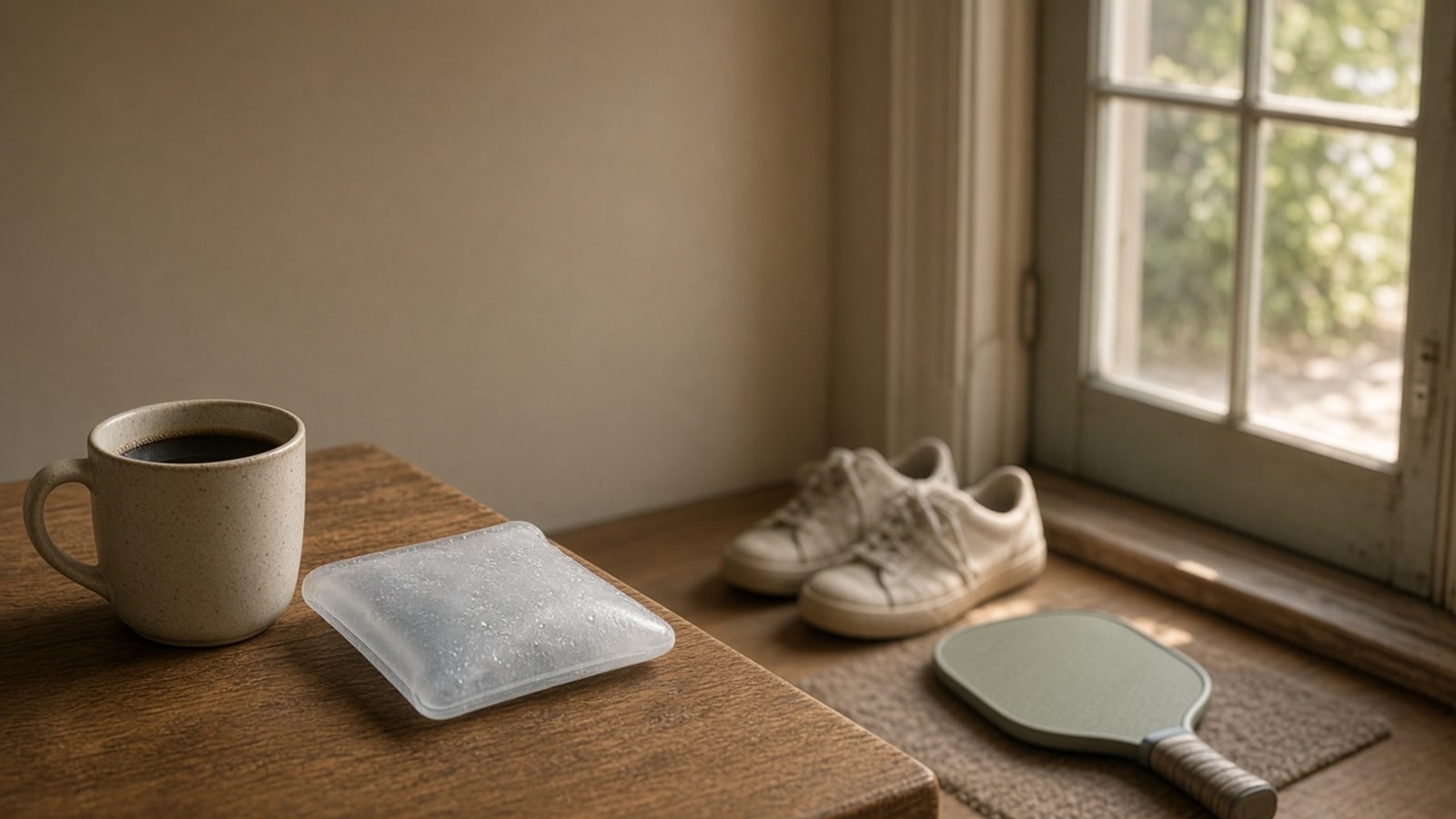
My left knee was scoped in 2015 and my right in 2021. Neither one is fragile, and neither one is twenty years old. In the first five minutes of a game, before I am warm, both of them complain when I move sideways. After ten minutes, they mostly stop.
That is not a coincidence and it is not a sign I should push through. A cold joint and cold muscle do not handle quick lateral movement well. The first hard cut of the morning is the one that does the damage, and it is usually in the first game. So the warm-up exists to make the first game less stupid.
The eight minutes
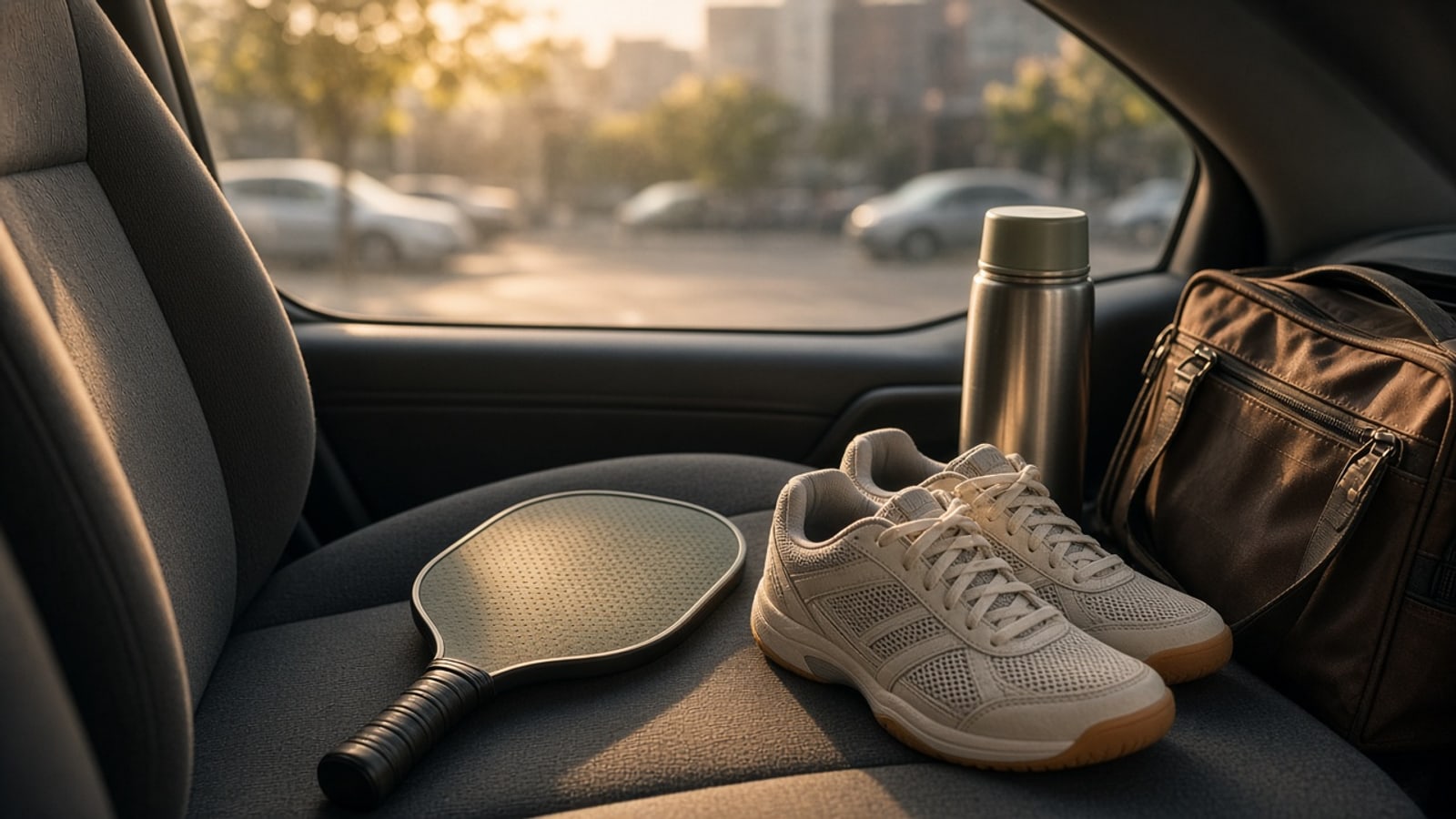
This is the routine. It fits between the car and the first serve, and it does not require a gym.
| Step | Time | Why |
|---|---|---|
| Walk around the courts | 3 minutes | Raises body temperature and gets the knees moving before any lateral work |
| Ten slow bodyweight squats | 1 minute | Warms the quads and hips through a range you will actually use |
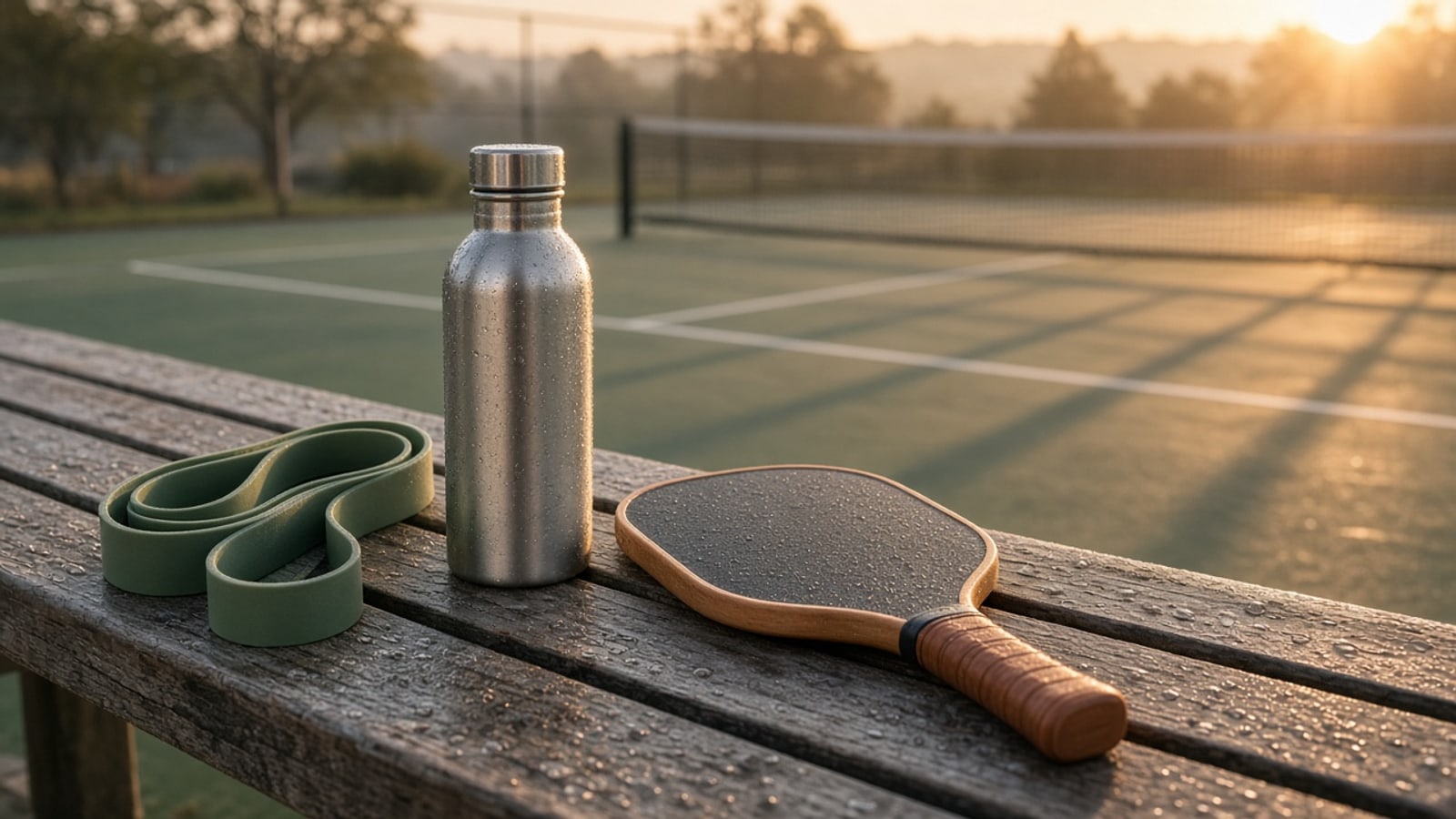
| Ten band pull-aparts | 1 minute | Wakes up the shoulders before the first serve, not after |
| Ten gentle torso rotations | 1 minute | Prepares the trunk for the rotation in a serve and a backhand |
| Easy dinks with a partner | 2 minutes | Gets hand-eye timing without loading the body |
Two things about this list. First, the order matters. Movement before load. Second, the dinks at the end are part of the warm-up, not the start of the game. I hit twenty easy dinks before I hit a serve. It feels silly for about a week and then it becomes the best two minutes of the session.
The cold-morning version
On a 40-degree morning, the eight minutes become twelve. I walk for five, not three, and I do the band work indoors before I go out. The squats are slower and there are ten of them, not fifteen. Cold tissue does not need more load; it needs more time.
The mistake I see at the courts in January is a player getting out of a warm car, walking twenty feet, and hitting a hard serve as the first ball of the morning. That is not a warm-up. That is a test of how the shoulder feels about surprises. Mine has opinions, and I have learned to ask politely first.
If the courts are icy, I skip the lateral movement entirely and play the first game as a social one, with soft dinks and no overheads. There is no prize for the hardest first serve of the day.
Sore is not hurt
This is the distinction I use, and I am not a doctor, so it is experience rather than medicine.
Sore is broad. It is an ache across a muscle group that gets better when you move and is gone in a day or two. It is the normal price of using a body.
Hurt is sharp, local, and often worse the next morning. It is the thing that makes you say "there" when someone asks where it hurts. Hurt does not get a game. It gets a rest day, and if it is still there after a few days, it gets a professional opinion instead of another round of guessing.
Most of the players I know who got hurt badly did not get hurt in a dramatic moment. They got hurt by playing through the third straight day of something that was already talking to them.
The three-day rule
I play Wednesday and Saturday mornings, and Friday with a group of retired first responders. That is three sessions a week, rarely three in a row. When I do play three days in a row, the next day is a walk, not a match.
This is not a rule I invented from research. It is the schedule I negotiated with my own body after the second knee scope. Two days in a row is fine. Three is the edge. Past that, the small complaints start to stack and the fourth day is a bad idea.
If you are retired and newly obsessed, this is the paragraph to underline. The game becomes available every morning, and available is not the same as advisable.
What I stopped doing
The long hamstring stretch before play. I used to hold it for a minute on each side, because that is what I did when I was young and playing other sports. It never made my first game better. Some mornings it made my back feel stiff.
Now I do the longer holds after the game, when the muscle is warm, or on a separate day when I am not playing at all. If you want a stretch routine, build one for the evening and leave the pre-game minutes for movement.
One more thing I stopped: playing through a sharp pain because my partner was counting on me. I have cancelled a game for that reason, and the group survived. My partner found a fourth. The courts were still there the next week.
If your third shot is the thing that falls apart when your knees are tired, Marcus wrote about the target problem in the third-shot drop is a target problem. And if you are the person organizing the group, Dottie's piece on the new couple at 7:25 is a good place to start.