The first time I tried to teach the third-shot drop to a friend, I told him to aim for the net. That was wrong, and it took me two seasons of watching balls sail past the baseline to figure out why. The net is not the target. The kitchen line is, and it sits about four feet behind the net. If you aim at the net, your brain solves for a shorter distance and your hand supplies a little more power than the shot needs. The ball lands long, you blame your touch, and you buy a paddle with more control. The paddle was never the problem.
The fix is boring and it works. Aim four feet deeper, move your target, and stop trying to feel your way to the line.
The net is the wrong target
At the Tuesday morning game at the Caldwell courts, my friend Dave hits a decent third shot in warmups. In a game, he misses long by two or three feet. Same player, same paddle, same swing. The only thing that changes is the target he is picturing.
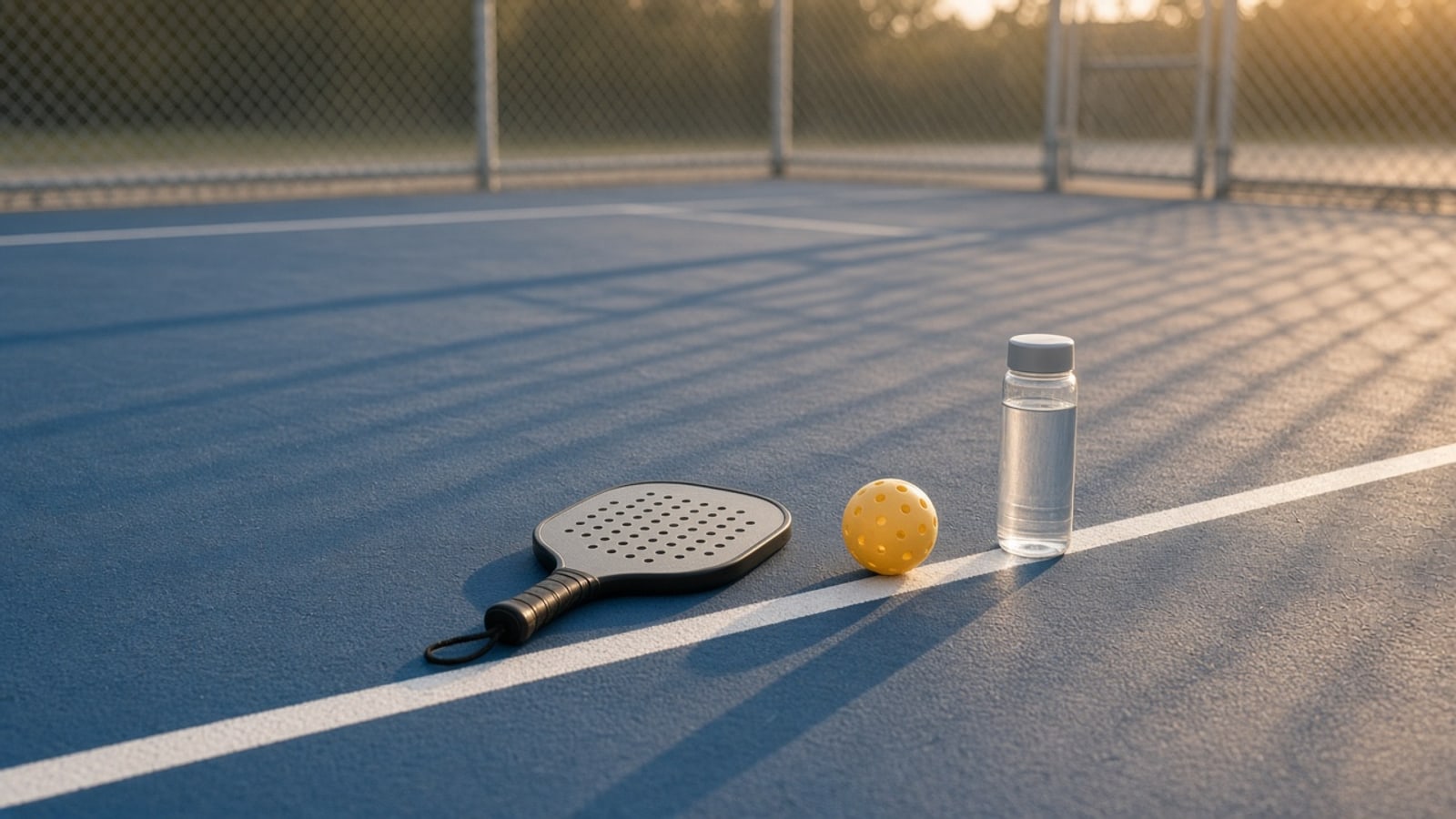
I set a water bottle on the kitchen line one morning and asked him to land three of ten balls on it. He landed one. Then I asked him to forget the net and aim at the bottle. He landed four. Nothing about his swing changed. What changed was the picture in his head.
That is the whole lesson, and it is the cheapest lesson in this game. A paddle costs more than a water bottle and fixes less.
The bottle drill: three balls, twenty minutes
You do not need a machine, a coach, or a partner for this. You need a target and a willingness to look silly alone on a court.
- Put a water bottle, a cone, or a towel on the kitchen line. The line itself is a fine target if you have nothing else.
- Stand at the baseline with three balls. Drop one from waist height and hit a soft drop toward the line.
- Judge the result by where it lands, not by how it feels. Long is long. Wide is wide. Short is short.
- Do ten from the same spot. Then move two feet left and do ten more.
- Stop after twenty minutes. Fatigue makes you swing harder, and swinging harder is the mistake you are trying to unlearn.
I do this on the Friday morning before league, which is also the day I am most likely to overhit. It has done more for my third shot than three years of buying paddles did.
Why the wrist opens under pressure
When a ball comes at you faster than you expect, your body does the safe thing: it braces and lifts the paddle face. That lifted face turns a soft drop into a pop-up, and a pop-up into an easy put-away for the team at the net. The wrist opens, the ball rises, and the point is gone.
The correction is not "swing softer." Slower swings with an open face still fly long. The correction is to hold the paddle face closed through the contact and let the ball come to you. Think of the paddle as a wall you are putting in front of the ball, not a racket you are swinging through it.
I learned this from a 4.0 player who beat me 11-3 using what looked like a lazy swing. It was not lazy. It was a closed face and almost no backswing.
What to change on a fast court
Indoor courts are faster, the ball skids, and the same swing that drops nicely outdoors will land at the baseline indoors. Two adjustments, both small.
First, add about two feet to your target. Aim at the middle of the kitchen, not the line. Second, shorten the backswing. On a slow outdoor court you can afford a little loop. Indoors, the loop is extra energy you do not need and cannot control.
| Miss | What it feels like | What to change |
|---|---|---|
| Long by two or three feet | A good swing, a bad result | Aim at the kitchen line, not the net |
| Pop-up into the net player | Contact out in front of the body | Let the ball come closer, hold the face closed |
| Wide by a foot | Rushing the shot | Pause at the top of the backswing, then let it go |
| Short into the net | Decelerating through contact | Finish the motion, do not stop the paddle at the ball |
None of these fixes require a purchase. That is the part I like.
The five-minute version
If you only have five minutes before your next game, do this. Put a bottle on the kitchen line. Hit ten drops with no partner. Count how many land on the right side of the line, then play your first game with that number in your head instead of a swing thought.
You will still miss. The drop is not a solved shot, and anyone who tells you otherwise has not played with a crosswind. But you will miss with a target, and a target is something you can practice.
If grip size is the thing that actually hurts your hand when you practice, that is a different problem with a cheaper solution. I wrote about it in how to measure your grip before you buy another paddle. And if you are over fifty and your elbow is the reason your third shot is inconsistent, the warm-up in the warm-up I do at fifty-eight is where I would start.