The first Thursday I walked into the drop-in, the room did not exactly go quiet, but it did notice. I was 32, I had a tennis bag, and I was walking into a church gym where the average age was somewhere north of 60. A man in a knee brace looked at me the way a person looks at a loud car, and a woman in a visor said, "You are younger than my daughter."
I had been invited by a friend of my mother's. I thought I would be bored. I had played Division II tennis and coached high school kids all week, and I figured a recreational pickleball game would be a light workout with a lot of standing around. I was wrong about that.
I have been going back for three years. I am still usually the youngest player in the room, and I have learned that being the youngest is a role with rules. Nobody hands them to you. You figure them out, or you do not get invited back.
What I got wrong about the slow game
My tennis instinct is to hit through the ball. If a ball comes at me, my body wants to move forward and put pace on it, and for the first month I did that in pickleball and I lost. A lot.
The people I was playing against did not beat me with speed. They beat me with patience. A woman named Ruth, who is 68 and plays with a paddle older than my car, would reset my hardest drive into the kitchen and then wait. She would do it four times in a row. By the fifth ball I was leaning in, and then she would place one behind me, and I would stand there looking at a ball I could have reached if I had not been trying to win the point on the previous shot.
I spent the first month thinking I was losing to old legs. I was losing to a better understanding of the game. That was a useful humiliation, and I am grateful for it, although I did not feel grateful at the time.
Do not coach your elders
I coach teenagers for a living. The temptation to coach adults is real and it is a trap.
In my second week, I told a man on my side that his backhand would be more consistent if he turned his shoulder. He looked at me for a second and said, "I have been playing for six years. How long have you been playing?" I said four weeks. He nodded and went to serve. He was not rude. He did not have to be. The point landed.
I made a rule for myself that day, and it is the same rule I have about my own father, who has a backhand that would make a tennis coach weep. Unless someone asks, I do not correct. If they do ask, I keep it to one thing and I keep it small. And if I have something that might help, I offer it as a question, because a question lets a person decide, and a correction does not.
Here is the thing I did not expect. They started asking me. Not about their backhands. About the serve, the toss, and how to get more power without swinging harder. I had spent years teaching those things to teenagers, and I could finally be useful at the drop-in, on their terms, after they had decided I was worth asking.
What they taught me in one game
The most useful hour of pickleball instruction I have ever received happened in a game I did not win.
I was partnered with Ruth and a retired accountant named Walt, who had the softest hands I have ever seen and never seemed to be moving fast. The opponents were a pair in their sixties who had clearly played together for years. I hit a drive, they returned it low, Ruth reset it, I hit another drive, and by the third exchange I noticed I was the only one out of position.
Ruth said, after the game, "You are watching the ball. Watch the paddle." She said it once. She did not explain it. It took me a month to understand, and then it took me another month to do it.
I think about that hour more than I think about almost any tennis lesson I have had. The game on a mixed-age court is a different game from the one I grew up playing, and the people who have been playing it for years are the ones who can teach it. They have solved problems I have not encountered yet, like how to play when the legs are honest about their limits, and how to keep a point alive when you cannot run.
If you are younger and faster, there is a version of the game where you hit winners and feel good. There is another version where you learn to reset, and that version is more fun and lasts longer. Kevin Tran has a good piece on the footwork side of that in footwork for players who hate footwork. The rest of it, the patience part, I do not think you can read. Someone has to beat it into you over a few months.
How to be the fourth
If you are the youngest player walking into a group like mine, here is what I would do, and it is not complicated.
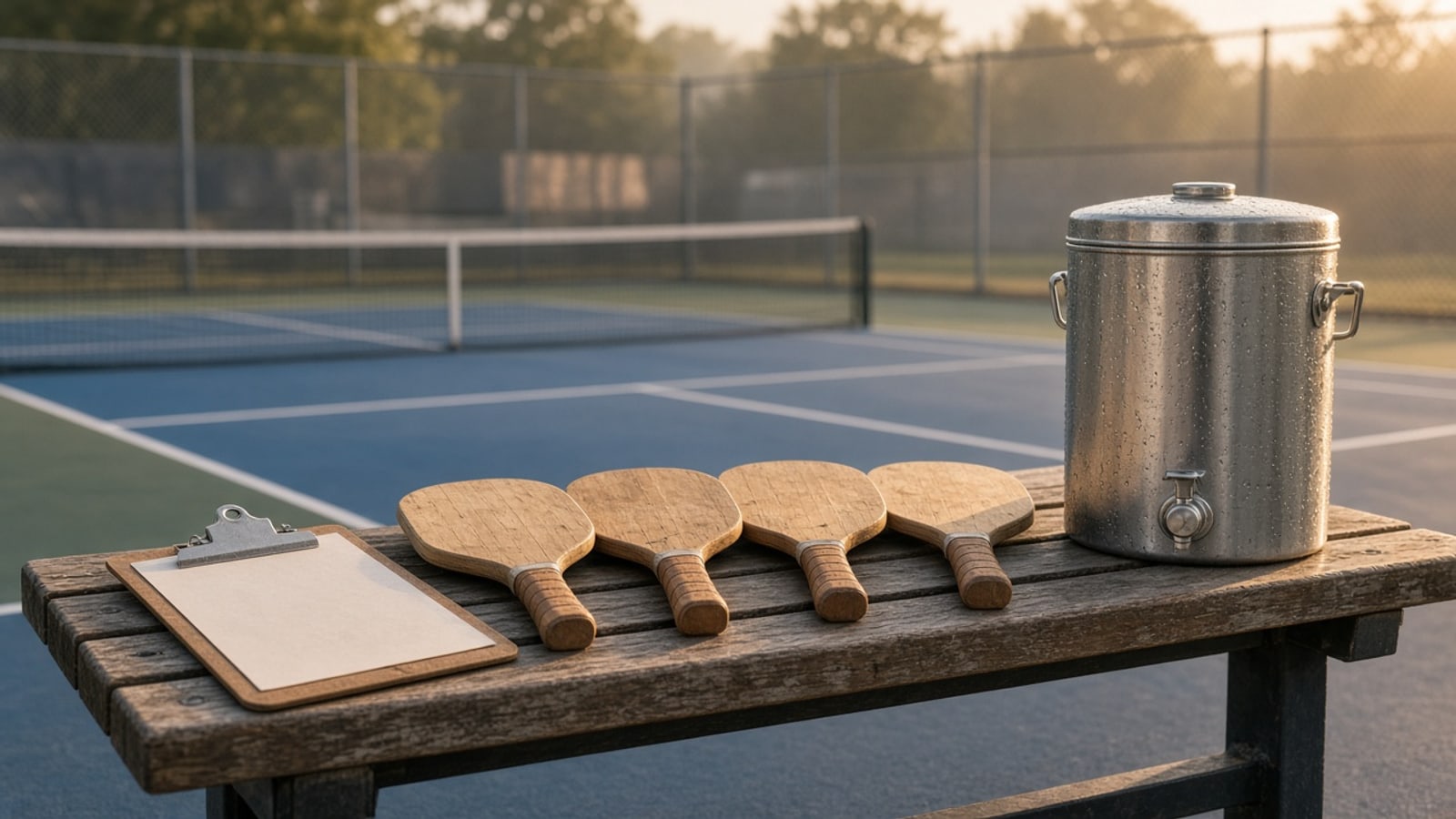
Arrive fifteen minutes early. Bring three balls. Introduce yourself to whoever runs the clipboard and ask who needs a fourth. If they ask your level, tell the truth. Underselling is charming for one day and annoying for a season. Then play the first game with the goal of making the rally last, not of winning the point.
Learn two names, and remember them. Help stack the chairs at the end, even if nobody asked. Say yes to the coffee after, because that is where the group actually happens, and because the people who skip the coffee are the people whose names nobody learns.
Dottie Frasier has written about what the group owes the new player in the new couple at 7:25. This piece is the other half. The group owes the newcomer a welcome, and the newcomer owes the group a little patience with the way things are done. Both halves are required.
I do not play with my high school kids. I play with my parents on Sunday, and with Ruth and Walt on Thursday, and with whoever needs a fourth, and it is the most fun I have with a paddle. My father still beats me with that backhand. I have stopped wanting to fix it.