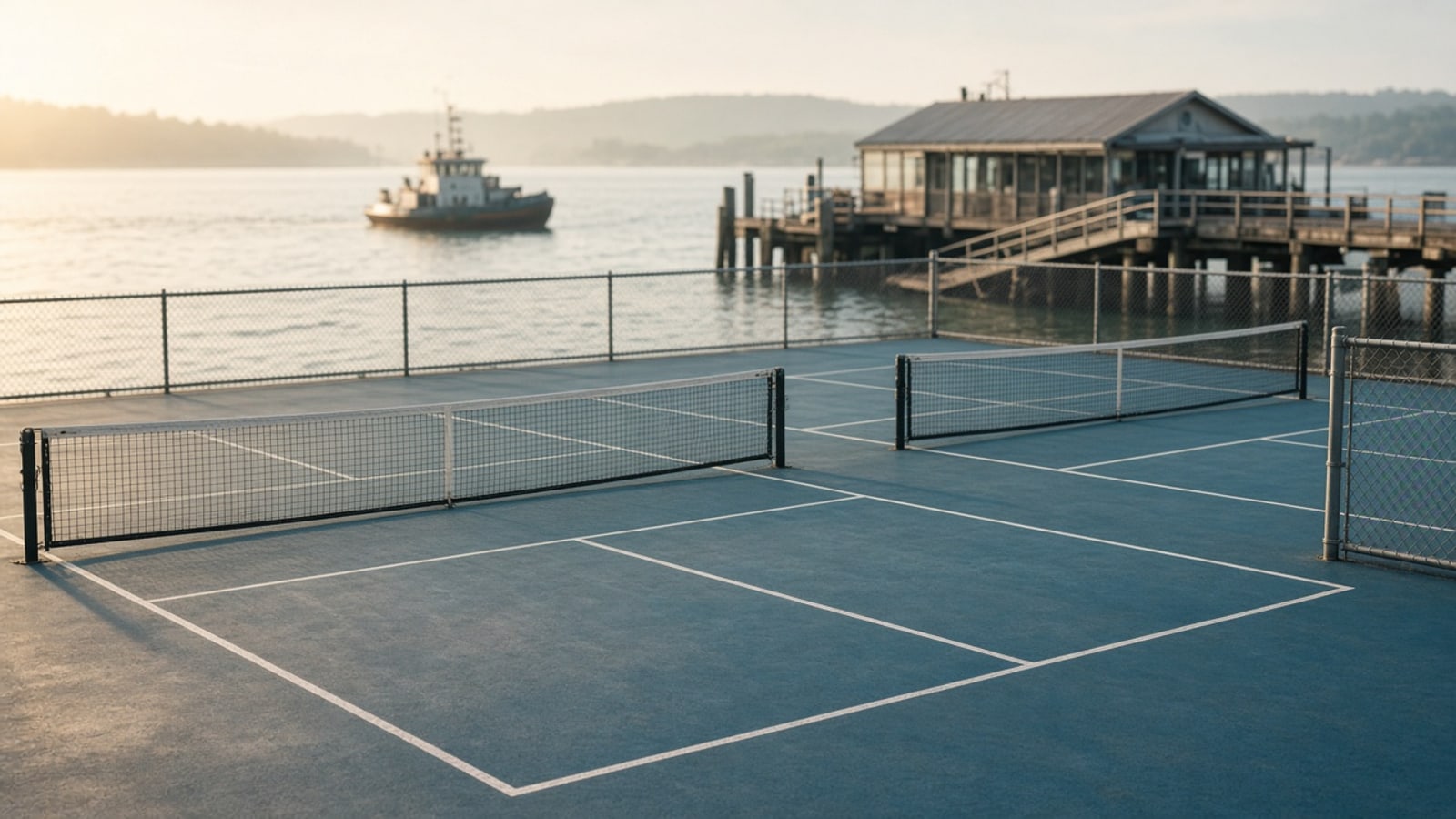
The court was a painted slab next to a ferry terminal on the water, four squares of blue and green with a net on a wheeled base, and a sign that said open play at eight. I found it because I had an hour to kill before a ferry and I always look out the window of a rental car for painted lines the way other people look for good coffee.
I was there at 8:10, alone, in a wind that came off the water in long pushes and then stopped for ten seconds as if it were deciding something. By 8:20 a man in a windbreaker had arrived with a milk crate of balls and a thermos, and he said, "You waiting for the ferry or the game?"
I said the game. He said, "Then you are early by local standards."
What a court by the water asks of you
Every court has a personality, and this one had two: wind and grit. The wind came across the water and made a soft dink into a guessing game. The surface was painted asphalt with sand on it in the corners, which meant the ball skidded low and my shoes did not grip the way they do on a clean indoor floor.
I have a rule about playing outdoors now: read the wind before you read the net. On that court you could feel it on your cheek, and the regulars had already adjusted. They kept everything low. They stood a step closer to the kitchen line on the upwind side. They served into the wind when they could, because a serve that dies in the wind is a serve that stays in.
The other thing the water does is change the light. At 8:30 the sun came across the lot at a low angle and the ball disappeared whenever it got above the net on the far court. The regulars had solved it by choosing sides and by hitting a lot of low balls, which is a good habit on any court and a survival skill on this one.
How I got a game
There is no clever method. I walked to the fence, waited for a break, and asked the man with the milk crate if they needed a fourth. He asked my level. I said 3.0 to 3.5, mostly doubles, and he said, "Good enough for the fourth court."
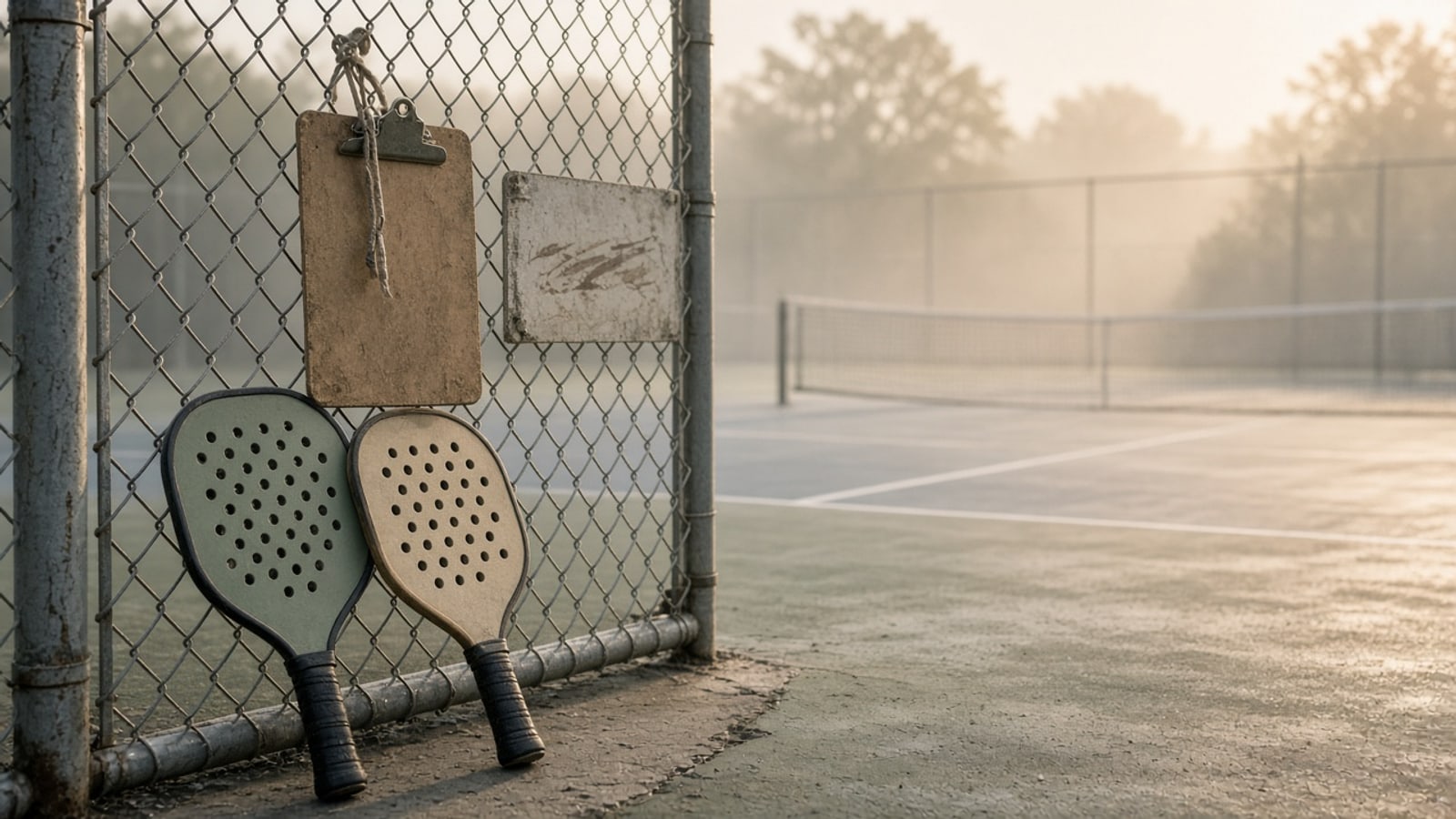
The group was nine people, mostly retired, and they had a rotation that lived on a clipboard hanging from the fence. I was written in at the bottom. I played three games in an hour, with three different partners, and I lost two of them. Nobody cared. The woman I played with in the third game, a retired teacher named Anne, said the wind would drop around nine and be back by ten, and she was right in both directions.
That is the part of travel pickleball that hotels cannot sell you. The local group knows when the wind drops, which side is unplayable at sunset, and which court leaks when it rains. You cannot find that on a website. You find it by showing up early and asking.
If you want the full method for arriving in a new town, I wrote about it in how to get a game in a town you have never played. The short version is: arrive early, bring balls, ask at the fence, and let the group decide where you fit.
The 8 a.m. game, which was really the 8:20 game
The sign said eight. The game started at 8:20 and the regulars knew that, and if I had been the kind of traveler who arrives exactly on time I would have stood alone for twenty minutes and left thinking the court was dead.
This is true almost everywhere. The posted start time is the earliest possible time, and the actual start time is when the second and third players arrive. If you are visiting, arrive a half hour after the posted time and you will look like a person who knows the rhythm. If you are early, use the time to walk the courts, check the surface, and find the restrooms, which on this court were inside the ferry terminal and required a code from the ticket counter.
What I would do again, and what I would skip
I would do the whole thing again. The court, the wind, the milk crate, Anne telling me about the tide. It cost nothing and it is the hour of that trip I remember best.
What I would skip is the ferry terminal breakfast, which was a packaged pastry and a coffee that had been sitting since six. I would walk into town instead, which I did after the second ferry, and find a diner with a counter. Joe, who does not play and drives, has a rule that the breakfast is half the reason for the trip, and he is right.
The practical notes, since I know you are planning: parking was free and easy before nine. There were two restrooms inside the terminal and a water fountain near the ticket window. The courts had no shade and no benches, so bring a hat and plan to sit on your bag. The surface was rough asphalt, fine for a casual game, hard on the knees if you play three hours, and the wind made a mockery of any lob hit above the net.
And the nets stayed up, which is the thing to check. A court with painted lines and no nets is a parking lot with optimism.
The notebook
I keep a notebook of courts, and the ferry terminal page is one of the shortest. Surface, shade, restrooms, parking, wind, who to ask, where to eat. That is it. I have pages for fancy resort courts with beautiful surfaces and no players, and pages for cracked slabs where the game was the best part of a week. The worst pages are for courts that looked good in a brochure, and I wrote about those in the hotel court that is not worth unpacking for.
The best court on a trip is rarely the nicest one. It is the one where somebody says, "You waiting for the ferry or the game?" and then writes your name on a clipboard. That happened here, and I have been trying to find it again ever since, on every trip, in every town with painted lines.